12 E-Commerce operators share how they scale operations. → Get the ERP Playbook.
Multichannel Integration in E-commerce: From Connected Channels to Connected Operations
Multichannel Integration in E-commerce: From Connected Channels to Connected Operations


An Amazon order enters the ERP. Inventory is reserved, the 3PL ships the goods, tracking and stock movements flow back, and finance can allocate the payout, fees and cost of goods sold.
That is what a working multichannel integration looks like.
In many growing e-commerce businesses, automation ends at the order import. Customer service checks several systems, operations corrects inventory, returns require follow-up, and finance pieces the numbers back together at month-end.
The channels are connected. The teams are holding the process together.
The architecture that changes this depends on the operating model behind the channels: warehouse structure, fulfillment routes, inventory logic, payment flows and ownership.
TL;DR
A successful order import says little about the process behind it. The real test is fulfillment, order changes, returns, payments and inventory valuation.
Complexity comes from different warehouses, fulfillment routes, inventory pools, payment flows and responsibilities — not simply from adding more sales channels.
The right setup may be a direct connector, Shopify as a hub, marketplace middleware, an ERP or a combination. Start with a real order, not a systems wish list.
The order import says very little
An order import is visible and easy to test. An order is placed on Amazon, appears shortly afterwards in the store, inventory system or ERP, and earns a green tick in the project plan.
For the business, the real test starts there.
In an initial call, one business owner described his live system roughly like this: as long as an order moves through in a straight line, everything works. The moment a customer removes an item or changes a quantity, the postings become unclear and hardly anyone on the team knows how to move the order forward.
Normal deviations reveal the quality of the integration.
The systems need to identify the product, confirm availability and route the order to the right fulfillment partner. Shipping status and tracking need to flow back. Changes, partial shipments and returns must preserve the link between order, stock, payment and accounting.
When the system landscape cannot do that, people become the integration layer. They export lists, reconcile statuses, chase information in Slack or email, and maintain the same data in several places.
I call these setups “human APIs.” At low volumes, they can work surprisingly well for a long time. Two people coordinate informally, an Excel file tracks the important exceptions, and someone knows which number to trust when systems disagree.
More orders, more people and more channels eventually turn that practical workaround into a bottleneck.
The operating model creates the complexity
A business with one Shopify store, a third-party logistics provider and a specialist accounting tool can have a lean order-to-cash process. The order goes to the 3PL, is shipped there and then processed for accounting. With a manageable assortment, few exceptions and a small team owning the flow, this architecture may be entirely sufficient.
A business with several stores, five marketplaces, an additional B2B operation, its own warehouse, FBA inventory and in-house accounting faces a different problem. Several fulfillment routes, inventory types, pricing logics and payment flows run in parallel.
Two channels with different operating models can therefore be more complex than five channels whose orders are always handled in the same way.
The first architecture question is:
What happens after a sale — and which team or system owns each step?
An Amazon order enters the ERP. Inventory is reserved, the 3PL ships the goods, tracking and stock movements flow back, and finance can allocate the payout, fees and cost of goods sold.
That is what a working multichannel integration looks like.
In many growing e-commerce businesses, automation ends at the order import. Customer service checks several systems, operations corrects inventory, returns require follow-up, and finance pieces the numbers back together at month-end.
The channels are connected. The teams are holding the process together.
The architecture that changes this depends on the operating model behind the channels: warehouse structure, fulfillment routes, inventory logic, payment flows and ownership.
TL;DR
A successful order import says little about the process behind it. The real test is fulfillment, order changes, returns, payments and inventory valuation.
Complexity comes from different warehouses, fulfillment routes, inventory pools, payment flows and responsibilities — not simply from adding more sales channels.
The right setup may be a direct connector, Shopify as a hub, marketplace middleware, an ERP or a combination. Start with a real order, not a systems wish list.
The order import says very little
An order import is visible and easy to test. An order is placed on Amazon, appears shortly afterwards in the store, inventory system or ERP, and earns a green tick in the project plan.
For the business, the real test starts there.
In an initial call, one business owner described his live system roughly like this: as long as an order moves through in a straight line, everything works. The moment a customer removes an item or changes a quantity, the postings become unclear and hardly anyone on the team knows how to move the order forward.
Normal deviations reveal the quality of the integration.
The systems need to identify the product, confirm availability and route the order to the right fulfillment partner. Shipping status and tracking need to flow back. Changes, partial shipments and returns must preserve the link between order, stock, payment and accounting.
When the system landscape cannot do that, people become the integration layer. They export lists, reconcile statuses, chase information in Slack or email, and maintain the same data in several places.
I call these setups “human APIs.” At low volumes, they can work surprisingly well for a long time. Two people coordinate informally, an Excel file tracks the important exceptions, and someone knows which number to trust when systems disagree.
More orders, more people and more channels eventually turn that practical workaround into a bottleneck.
The operating model creates the complexity
A business with one Shopify store, a third-party logistics provider and a specialist accounting tool can have a lean order-to-cash process. The order goes to the 3PL, is shipped there and then processed for accounting. With a manageable assortment, few exceptions and a small team owning the flow, this architecture may be entirely sufficient.
A business with several stores, five marketplaces, an additional B2B operation, its own warehouse, FBA inventory and in-house accounting faces a different problem. Several fulfillment routes, inventory types, pricing logics and payment flows run in parallel.
Two channels with different operating models can therefore be more complex than five channels whose orders are always handled in the same way.
The first architecture question is:
What happens after a sale — and which team or system owns each step?
Hol dir das E-Commerce-ERP-Playbook
Hol dir das E-Commerce-ERP-Playbook
Ein strukturierter Leitfaden für die wichtigsten ERP-Entscheidung im wachsenden E-Commerce (+60 Seiten, 12 Expertinnen).
Ein strukturierter Leitfaden für die wichtigsten ERP-Entscheidung im wachsenden E-Commerce (+60 Seiten, 12 Expertinnen).
Mit Erfahrungen von Expert*innen, die täglich ERP, Ops & Zahlen verantworten.
Hol dir das E-Commerce-ERP-Playbook
Ein strukturierter Leitfaden für die wichtigsten ERP-Entscheidung im wachsenden E-Commerce (+60 Seiten, 12 Expertinnen).
Mit Erfahrungen von Expert*innen, die täglich ERP, Ops & Zahlen verantworten.
Six areas that need to work together
1. Product data, listings and pricing
A product needs a clear identity across every system. Variants, bundles, country-specific assortments, different SKUs and channel-specific prices make that complicated quickly.
The information can live in different places. Product copy and images may sit in the store or a PIM, while the ERP manages purchasing, inventory and valuation.
Each type of information still needs one designated source. When price, SKU or variant structure can be changed in several systems, conflicts are inevitable.
2. Inventory and availability
“Inventory” can describe several different quantities.
Stock may sit in your own warehouse, with a 3PL, across several FBA locations, with a contract manufacturer or in transit. Some of it may already be reserved, damaged or deliberately allocated to a specific sales channel.
In one ERP project, the B2C and B2B teams were competing for the same physical inventory. Because the logistics provider did not support the required reservation logic, identical products were assigned artificial, separate SKUs. When a B2B order came in, stock first had to be reversed and then reassigned.
Both teams wanted planning certainty. The workaround made inventory harder to understand and dependent on the knowledge of individual employees.
Before recreating a setup like that in the ERP, check whether allocation rules, a different reservation logic or a change at the logistics provider would solve the underlying problem.
3. Orders, payments and exceptions
An imported order needs to contain everything required for processing. Depending on the channel, that includes:
customer data
billing and delivery addresses
line items and quantities
taxes and discounts
payment status
shipping method
In one e-commerce project, B2B customer data was maintained across several Google Sheets and personal inboxes. Orders were then recreated manually in Shopify because Shopify was the only system connected to the external logistics provider. After shipment, the invoice was created separately. Payment status lived in accounting and was not directly visible to sales.
Each tool performed its own job. The team still had to reconstruct the transaction at every step.
In the target process, the customer and order are created once. The order goes to the logistics provider, whose shipping confirmation triggers the invoice and downstream accounting processes. Sales and operations can see in one place what was quoted, delivered, invoiced and paid.
4. Fulfillment and status feedback
Passing an order to a 3PL covers only half the flow. Shipping confirmation, tracking, inventory changes, goods receipts and return information all need to come back.
Moving goods from an external warehouse to Amazon to replenish FBA or Prime inventory also changes availability. The transfer must remain traceable across the ERP, the logistics provider and Amazon.
The fulfillment model has a major influence on the architecture. With an in-house warehouse, the business controls picking, packing and shipping. With a 3PL, the process depends on an external partner. FBA handles much of the execution but creates separate inventory, statuses, fees and return flows.
Many businesses operate several of these models at the same time.
5. Returns and refunds
Returns are part of the normal order-to-cash process.
A return changes at least four things:
the order,
the payment,
the physical inventory,
the financial valuation.
The returned item may be sellable again, damaged or need to be written off. A partial return affects different line items and amounts than a full cancellation.
If the marketplace knows about the refund, the warehouse records the condition in another system and finance posts the correction later, the return has been recorded several times. It still cannot be followed as one transaction.
6. Finance, inventory value and channel profitability
The financial feedback loop belongs in the integration architecture.
A marketplace payout includes more than revenue. Fees, refunds, discounts and delayed payments need to be allocated to the right orders. Calculating the actual margin also requires the value of the goods sold.
Revenue by channel does not reveal profitability. You need to trace which inventory left through that channel and what it was worth at the time. Purchase prices, exchange rates, freight and customs duties can all change that value.
Before the ERP project, PURISH had only one sales channel connected at a system level. Today, eight technically separate channel setups are represented in one shared structure, including Shopify, B2B, several marketplaces and Amazon FBA in Europe and the US.
For the annual close, inventory data previously had to be assembled from several systems and spreadsheets over a period of weeks. During the implementation, determining year-end inventory still took around one week. Today, the current inventory value can be calculated within minutes.
The larger gain comes from connecting the data. PURISH can see where inventory is located, through which channel it was sold and where the corresponding cost of goods sold arises.
Which system gets the final say?
An end-to-end architecture can include several specialist tools. Every team does not need to work in the same system, and an ERP does not need to replace every application.
For each business-critical piece of information, one system must settle conflicts:
Where is the customer record maintained?
Which system calculates available inventory?
Where is payment status recorded?
Which system tracks inbound goods?
Where is the binding product value calculated?
The store, PIM, ERP, marketplace software and accounting tools can own different tasks. Problems emerge when several systems are allowed to make the same decision or nobody knows which number wins.
A spreadsheet can be useful for analysis and planning. When it permanently carries information between core systems and teams, it has become an uncontrolled part of the architecture.
Six areas that need to work together
1. Product data, listings and pricing
A product needs a clear identity across every system. Variants, bundles, country-specific assortments, different SKUs and channel-specific prices make that complicated quickly.
The information can live in different places. Product copy and images may sit in the store or a PIM, while the ERP manages purchasing, inventory and valuation.
Each type of information still needs one designated source. When price, SKU or variant structure can be changed in several systems, conflicts are inevitable.
2. Inventory and availability
“Inventory” can describe several different quantities.
Stock may sit in your own warehouse, with a 3PL, across several FBA locations, with a contract manufacturer or in transit. Some of it may already be reserved, damaged or deliberately allocated to a specific sales channel.
In one ERP project, the B2C and B2B teams were competing for the same physical inventory. Because the logistics provider did not support the required reservation logic, identical products were assigned artificial, separate SKUs. When a B2B order came in, stock first had to be reversed and then reassigned.
Both teams wanted planning certainty. The workaround made inventory harder to understand and dependent on the knowledge of individual employees.
Before recreating a setup like that in the ERP, check whether allocation rules, a different reservation logic or a change at the logistics provider would solve the underlying problem.
3. Orders, payments and exceptions
An imported order needs to contain everything required for processing. Depending on the channel, that includes:
customer data
billing and delivery addresses
line items and quantities
taxes and discounts
payment status
shipping method
In one e-commerce project, B2B customer data was maintained across several Google Sheets and personal inboxes. Orders were then recreated manually in Shopify because Shopify was the only system connected to the external logistics provider. After shipment, the invoice was created separately. Payment status lived in accounting and was not directly visible to sales.
Each tool performed its own job. The team still had to reconstruct the transaction at every step.
In the target process, the customer and order are created once. The order goes to the logistics provider, whose shipping confirmation triggers the invoice and downstream accounting processes. Sales and operations can see in one place what was quoted, delivered, invoiced and paid.
4. Fulfillment and status feedback
Passing an order to a 3PL covers only half the flow. Shipping confirmation, tracking, inventory changes, goods receipts and return information all need to come back.
Moving goods from an external warehouse to Amazon to replenish FBA or Prime inventory also changes availability. The transfer must remain traceable across the ERP, the logistics provider and Amazon.
The fulfillment model has a major influence on the architecture. With an in-house warehouse, the business controls picking, packing and shipping. With a 3PL, the process depends on an external partner. FBA handles much of the execution but creates separate inventory, statuses, fees and return flows.
Many businesses operate several of these models at the same time.
5. Returns and refunds
Returns are part of the normal order-to-cash process.
A return changes at least four things:
the order,
the payment,
the physical inventory,
the financial valuation.
The returned item may be sellable again, damaged or need to be written off. A partial return affects different line items and amounts than a full cancellation.
If the marketplace knows about the refund, the warehouse records the condition in another system and finance posts the correction later, the return has been recorded several times. It still cannot be followed as one transaction.
6. Finance, inventory value and channel profitability
The financial feedback loop belongs in the integration architecture.
A marketplace payout includes more than revenue. Fees, refunds, discounts and delayed payments need to be allocated to the right orders. Calculating the actual margin also requires the value of the goods sold.
Revenue by channel does not reveal profitability. You need to trace which inventory left through that channel and what it was worth at the time. Purchase prices, exchange rates, freight and customs duties can all change that value.
Before the ERP project, PURISH had only one sales channel connected at a system level. Today, eight technically separate channel setups are represented in one shared structure, including Shopify, B2B, several marketplaces and Amazon FBA in Europe and the US.
For the annual close, inventory data previously had to be assembled from several systems and spreadsheets over a period of weeks. During the implementation, determining year-end inventory still took around one week. Today, the current inventory value can be calculated within minutes.
The larger gain comes from connecting the data. PURISH can see where inventory is located, through which channel it was sold and where the corresponding cost of goods sold arises.
Which system gets the final say?
An end-to-end architecture can include several specialist tools. Every team does not need to work in the same system, and an ERP does not need to replace every application.
For each business-critical piece of information, one system must settle conflicts:
Where is the customer record maintained?
Which system calculates available inventory?
Where is payment status recorded?
Which system tracks inbound goods?
Where is the binding product value calculated?
The store, PIM, ERP, marketplace software and accounting tools can own different tasks. Problems emerge when several systems are allowed to make the same decision or nobody knows which number wins.
A spreadsheet can be useful for analysis and planning. When it permanently carries information between core systems and teams, it has become an uncontrolled part of the architecture.
Hol dir das E-Commerce-ERP-Playbook
Ein strukturierter Leitfaden für die wichtigsten ERP-Entscheidung im wachsenden E-Commerce (+60 Seiten, 12 Expertinnen).
Mit Erfahrungen von Expert*innen, die täglich ERP, Ops & Zahlen verantworten.
Sometimes the sales channel is not the bottleneck
At a lighting manufacturer we work with, Shopify performed its role as a sales channel and the existing ERP handled shipping and billing. The bottleneck started after the order.
Production was managed through a home-built dashboard and a great deal of manual knowledge. Inventory figures, guided manufacturing steps and a simple user experience were missing. At the same time, the business brings in many new seasonal workers.
The production flow needed to show employees at every station what to do next and help new colleagues become productive quickly.
Another interface would have left that problem untouched. The production process had to work first.
Which integration architecture fits?
Direct integration
Fits when: one stable data flow needs to be automated and exceptions are rare.
Becomes risky when: several processes, systems and edge cases converge in the same flow.
Shopify as the hub
Fits when: Shopify runs the operational process and orders from every channel are handled in largely the same way.
Becomes risky when: purchasing, B2B, FBA, multiple inventory pools and detailed valuation become more important.
Marketplace middleware
Fits when: listings, prices and onboarding across many marketplaces form a separate operational function.
Becomes risky when: the middleware becomes another data hub without a clear owner.
ERP-centered or hybrid architecture
Fits when: sales, purchasing, inventory, fulfillment and finance are tightly interdependent.
Becomes risky when: the project expands unnecessarily or working specialist tools are replaced without a concrete reason.
Choose the smallest architecture that can carry orders, stock, payments and returns without permanent manual bridges.
How to derive the architecture from the process
In our discovery sessions, we start with a real order and follow it from the sale through to its financial valuation.
1. Follow the real flow
Where are the product, price and order created? Where does availability come from? Who owns fulfillment, invoicing and payment?
Use the process people actually follow, not the version documented in an old project plan.
2. Test normal deviations
Walk through an order change, partial shipment, cancellation, return, damaged item and invoice discrepancy.
A process that depends on untouched standard orders will quickly require manual intervention.
3. Assign system ownership and involve finance
Product data, inventory, orders, payments and inventory value each need a leading system. At the same time, the team must define how revenue, fees, refunds and cost of goods sold are allocated to each channel.
Bringing finance in shortly before go-live almost always creates more reconciliation work.
4. Limit the first scope
Now you can decide whether one connector is enough or whether the process requires a hub, middleware, an ERP or a hybrid setup.
The first scope needs to carry the chosen end-to-end process. It does not need to include every feature the business may want later.
Self-check: are your sales channels integrated?
Do orders arrive centrally but still require regular checking, completion or re-entry?
Does the process break when a customer changes an order?
Do the store, marketplace, warehouse and ERP show different inventory figures?
Are status and inventory updates missing after orders move to a 3PL or FBA?
Does customer service open several systems to understand one order?
Are cancellations, partial shipments or returns handled outside the standard process?
Do Excel, Slack, email or manual exports permanently connect your core systems?
Can finance allocate revenue, fees, returns and cost of goods sold by channel?
Several “yes” answers justify following the process from the order through to accounting.
The result may be one missing connector, unclear ownership or inconsistent data logic. It may also show that the system landscape no longer fits the operating model. A new ERP is one possible answer, not the default.
Conclusion: integration begins after the order import
A sales channel is integrated when the order, stock, payment and return move through the business as one traceable transaction.
The number of systems is secondary. A direct connector may be enough. Businesses with several fulfillment models, inventory pools and payment flows may need an ERP as the operational backbone.
The best architecture is the smallest one that carries the actual process.
A new channel should create more business — not another spreadsheet, more control work and a new set of exceptions.
In our Discovery Assessment, we follow a real order through your systems, from the sale and stock movement to fulfillment and finance. You leave knowing where the process breaks, which system needs to lead and what actually needs to change.
Frequently asked questions about multichannel integration
What is multichannel integration in e-commerce?
Multichannel integration connects sales channels to the operational and financial processes behind them. Alongside product data, prices, inventory and orders, that includes fulfillment, returns, payments and inventory valuation.
When is a direct connector enough?
A direct connector often works well for a stable process with few exceptions. Several fulfillment routes, inventory pools or payment flows usually require broader process coordination.
What is the difference between multichannel and omnichannel?
Multichannel means selling through several channels. Omnichannel also emphasizes a consistent customer experience across touchpoints. Both depend on functioning data and process flows between the systems involved.
Which system should be the source of truth?
The answer depends on the information. The store or PIM may own product content, while the ERP owns inventory, stock movements and financial valuation. Each information type needs one designated source and a rule for resolving conflicts.
Where should an integration project begin?
Start with a real order. Follow it through fulfillment, changes, returns, payment and inventory valuation. The breaks in that flow show which integration the business actually needs.
Sometimes the sales channel is not the bottleneck
At a lighting manufacturer we work with, Shopify performed its role as a sales channel and the existing ERP handled shipping and billing. The bottleneck started after the order.
Production was managed through a home-built dashboard and a great deal of manual knowledge. Inventory figures, guided manufacturing steps and a simple user experience were missing. At the same time, the business brings in many new seasonal workers.
The production flow needed to show employees at every station what to do next and help new colleagues become productive quickly.
Another interface would have left that problem untouched. The production process had to work first.
Which integration architecture fits?
Direct integration
Fits when: one stable data flow needs to be automated and exceptions are rare.
Becomes risky when: several processes, systems and edge cases converge in the same flow.
Shopify as the hub
Fits when: Shopify runs the operational process and orders from every channel are handled in largely the same way.
Becomes risky when: purchasing, B2B, FBA, multiple inventory pools and detailed valuation become more important.
Marketplace middleware
Fits when: listings, prices and onboarding across many marketplaces form a separate operational function.
Becomes risky when: the middleware becomes another data hub without a clear owner.
ERP-centered or hybrid architecture
Fits when: sales, purchasing, inventory, fulfillment and finance are tightly interdependent.
Becomes risky when: the project expands unnecessarily or working specialist tools are replaced without a concrete reason.
Choose the smallest architecture that can carry orders, stock, payments and returns without permanent manual bridges.
How to derive the architecture from the process
In our discovery sessions, we start with a real order and follow it from the sale through to its financial valuation.
1. Follow the real flow
Where are the product, price and order created? Where does availability come from? Who owns fulfillment, invoicing and payment?
Use the process people actually follow, not the version documented in an old project plan.
2. Test normal deviations
Walk through an order change, partial shipment, cancellation, return, damaged item and invoice discrepancy.
A process that depends on untouched standard orders will quickly require manual intervention.
3. Assign system ownership and involve finance
Product data, inventory, orders, payments and inventory value each need a leading system. At the same time, the team must define how revenue, fees, refunds and cost of goods sold are allocated to each channel.
Bringing finance in shortly before go-live almost always creates more reconciliation work.
4. Limit the first scope
Now you can decide whether one connector is enough or whether the process requires a hub, middleware, an ERP or a hybrid setup.
The first scope needs to carry the chosen end-to-end process. It does not need to include every feature the business may want later.
Self-check: are your sales channels integrated?
Do orders arrive centrally but still require regular checking, completion or re-entry?
Does the process break when a customer changes an order?
Do the store, marketplace, warehouse and ERP show different inventory figures?
Are status and inventory updates missing after orders move to a 3PL or FBA?
Does customer service open several systems to understand one order?
Are cancellations, partial shipments or returns handled outside the standard process?
Do Excel, Slack, email or manual exports permanently connect your core systems?
Can finance allocate revenue, fees, returns and cost of goods sold by channel?
Several “yes” answers justify following the process from the order through to accounting.
The result may be one missing connector, unclear ownership or inconsistent data logic. It may also show that the system landscape no longer fits the operating model. A new ERP is one possible answer, not the default.
Conclusion: integration begins after the order import
A sales channel is integrated when the order, stock, payment and return move through the business as one traceable transaction.
The number of systems is secondary. A direct connector may be enough. Businesses with several fulfillment models, inventory pools and payment flows may need an ERP as the operational backbone.
The best architecture is the smallest one that carries the actual process.
A new channel should create more business — not another spreadsheet, more control work and a new set of exceptions.
In our Discovery Assessment, we follow a real order through your systems, from the sale and stock movement to fulfillment and finance. You leave knowing where the process breaks, which system needs to lead and what actually needs to change.
Frequently asked questions about multichannel integration
What is multichannel integration in e-commerce?
Multichannel integration connects sales channels to the operational and financial processes behind them. Alongside product data, prices, inventory and orders, that includes fulfillment, returns, payments and inventory valuation.
When is a direct connector enough?
A direct connector often works well for a stable process with few exceptions. Several fulfillment routes, inventory pools or payment flows usually require broader process coordination.
What is the difference between multichannel and omnichannel?
Multichannel means selling through several channels. Omnichannel also emphasizes a consistent customer experience across touchpoints. Both depend on functioning data and process flows between the systems involved.
Which system should be the source of truth?
The answer depends on the information. The store or PIM may own product content, while the ERP owns inventory, stock movements and financial valuation. Each information type needs one designated source and a rule for resolving conflicts.
Where should an integration project begin?
Start with a real order. Follow it through fulfillment, changes, returns, payment and inventory valuation. The breaks in that flow show which integration the business actually needs.
More articles

How to Start an ERP Project Successfully: 9 Decisions That Need to Be Made Before Implementation
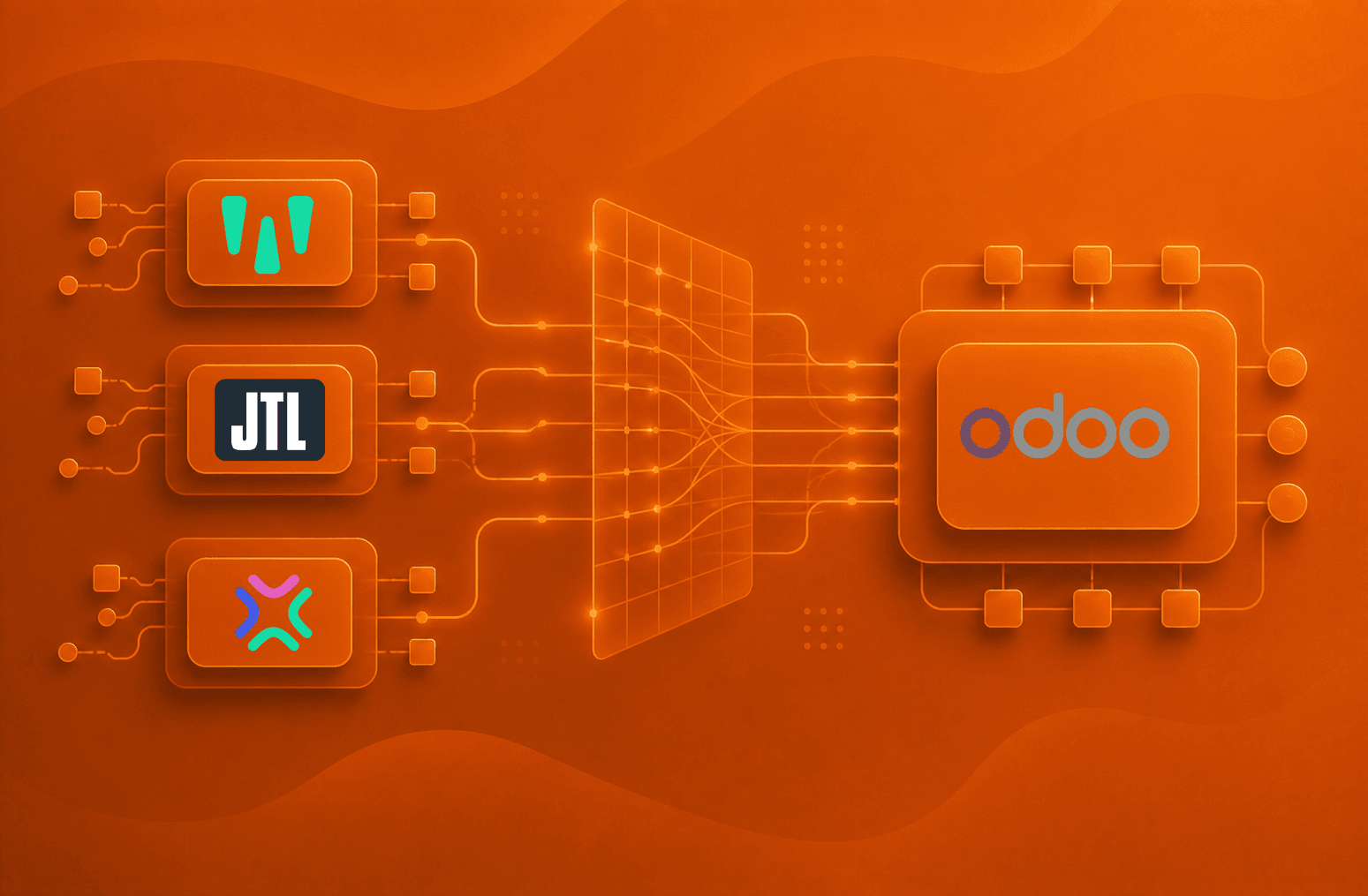
Switching ERP from weclapp, Xentral or JTL to Odoo: How companies migrate cleanly (process, risks and common mistakes)

ERP Implementation: 7 Risks That Make Projects Fail (and How to Spot Them Early)

Best-of-Breed vs. Best-of-Suite in Mid-Market: HubSpot vs. Odoo in a Reality Check

Controlling ERP in E-Commerce: How to Scale Without Losing Financial Control

Customer Service ERP: How to Integrate Service, ERP and Logistics Properly

E-Commerce Accounting ERP: When 60,000 Monthly Bookings Break Your System

E-Commerce Logistics & ERP: Why Fulfillment Becomes Structural at Scale

Made with🫀in Berlin © 2026 bobco GmbH
Made with🫀in Berlin © 2026 bobco GmbH
Made with🫀in Berlin © 2026 bobco GmbH