12 E-Commerce operators share how they scale operations. → Get the ERP Playbook.
Best-of-Breed vs. Best-of-Suite in Mid-Market: HubSpot vs. Odoo in a Reality Check
Best-of-Breed vs. Best-of-Suite in Mid-Market: HubSpot vs. Odoo in a Reality Check


Many growing companies start with specialized individual tools: “best of breed.” CRM here, project management there, accounting somewhere else. That often works surprisingly well. Until it doesn’t.
This article explains where best-of-breed setups tend to break down in mid-sized companies, when an integrated suite becomes the more sensible option, and how to make that decision properly.
TL;DR
HubSpot is often the better CRM, especially for sales, marketing, pipeline management, communication, and simple quote-to-cash processes.
In many growing mid-sized companies, CRM eventually stops being the main bottleneck. The real problem begins when a deal has to become a quote, an order, a project, a delivery, an invoice, and reliable numbers.
Best-of-breed works well when individual departments need to be optimized and the company has the competence to integrate and maintain several specialized tools properly.
Best-of-suite becomes relevant when the handovers between sales, delivery, operations, and finance become the actual problem. At that point, integration effort, duplicate data entry, meetings, and manual handovers cost more than specialized tools save.
The real decision is not: HubSpot or Odoo?
It is: Do we have a CRM/sales problem — or an integration problem across our operating model?
HubSpot vs. Odoo: The Comparison Is Often Flawed
If you look at CRM in isolation, HubSpot often beats Odoo.
HubSpot is strong in marketing automation, lead management, sales pipeline management, and classic go-to-market processes. With Commerce Hub, it can also cover — with some limitations — CPQ-adjacent processes, billing, payments, and subscriptions. For companies whose bottleneck clearly sits in sales, HubSpot is often the right choice.
Odoo plays a different role. It is not simply a CRM alternative. It is a suite of business apps covering areas such as CRM, e-commerce, accounting, inventory, point of sale, and project management.
The relevant point is not whether Odoo’s CRM module is better than HubSpot. The relevant point is that these areas can work together seamlessly on one platform. Odoo itself describes its core value in exactly this way: as an integrated business app suite for central company processes.
So the “HubSpot vs. Odoo” comparison breaks down when both systems are evaluated purely as CRM alternatives.
Many mid-sized companies do not need a better CRM. Their actual problem sits behind it: sales, delivery, inventory, and accounting work in separate systems, while Excel, meetings, and key individuals keep the process running.
At that point, the question is no longer whether sales can be organized better. The question is whether what starts in sales can move cleanly through quoting, orders, delivery, invoicing, and controlling.
A CRM question becomes a systems question.
Best-of-Breed: Strong Within a Single Department
Best-of-breed works well when a clearly defined problem needs to be solved.
A specialized tool makes sense when the bottleneck really sits inside one department, when the tool’s depth is actually used in day-to-day work, and — most importantly — when the interaction with other systems is clear. That last point is the critical one in the mid-market.
Several strong individual tools do not automatically create a strong system.
How Best-of-Breed Turns Into Fragmentation
Best-of-breed rarely starts as an architecture decision. Most of the time, it grows organically.
At the beginning, Excel and direct communication are enough. The team is small, knowledge lives in people’s heads, and edge cases can still be handled by asking someone.
Then the first department outgrows that way of working. Usually, that department is sales. The number of leads increases, the pipeline becomes harder to manage. So HubSpot gets introduced.
Then more bottlenecks appear across the company and along the value chain. Project management needs structure, finance needs an accounting system, operations needs inventory management. So more tools are added.
Locally, this is often progress. The overall process still becomes less efficient.
At some point, quotes, orders, project statuses, and billing data are spread across multiple systems. People copy data, ask follow-up questions, reconcile information, and consolidate everything in Excel.
We call this “human APIs.” The big problem appears in the handovers between tools.
Many growing companies start with specialized individual tools: “best of breed.” CRM here, project management there, accounting somewhere else. That often works surprisingly well. Until it doesn’t.
This article explains where best-of-breed setups tend to break down in mid-sized companies, when an integrated suite becomes the more sensible option, and how to make that decision properly.
TL;DR
HubSpot is often the better CRM, especially for sales, marketing, pipeline management, communication, and simple quote-to-cash processes.
In many growing mid-sized companies, CRM eventually stops being the main bottleneck. The real problem begins when a deal has to become a quote, an order, a project, a delivery, an invoice, and reliable numbers.
Best-of-breed works well when individual departments need to be optimized and the company has the competence to integrate and maintain several specialized tools properly.
Best-of-suite becomes relevant when the handovers between sales, delivery, operations, and finance become the actual problem. At that point, integration effort, duplicate data entry, meetings, and manual handovers cost more than specialized tools save.
The real decision is not: HubSpot or Odoo?
It is: Do we have a CRM/sales problem — or an integration problem across our operating model?
HubSpot vs. Odoo: The Comparison Is Often Flawed
If you look at CRM in isolation, HubSpot often beats Odoo.
HubSpot is strong in marketing automation, lead management, sales pipeline management, and classic go-to-market processes. With Commerce Hub, it can also cover — with some limitations — CPQ-adjacent processes, billing, payments, and subscriptions. For companies whose bottleneck clearly sits in sales, HubSpot is often the right choice.
Odoo plays a different role. It is not simply a CRM alternative. It is a suite of business apps covering areas such as CRM, e-commerce, accounting, inventory, point of sale, and project management.
The relevant point is not whether Odoo’s CRM module is better than HubSpot. The relevant point is that these areas can work together seamlessly on one platform. Odoo itself describes its core value in exactly this way: as an integrated business app suite for central company processes.
So the “HubSpot vs. Odoo” comparison breaks down when both systems are evaluated purely as CRM alternatives.
Many mid-sized companies do not need a better CRM. Their actual problem sits behind it: sales, delivery, inventory, and accounting work in separate systems, while Excel, meetings, and key individuals keep the process running.
At that point, the question is no longer whether sales can be organized better. The question is whether what starts in sales can move cleanly through quoting, orders, delivery, invoicing, and controlling.
A CRM question becomes a systems question.
Best-of-Breed: Strong Within a Single Department
Best-of-breed works well when a clearly defined problem needs to be solved.
A specialized tool makes sense when the bottleneck really sits inside one department, when the tool’s depth is actually used in day-to-day work, and — most importantly — when the interaction with other systems is clear. That last point is the critical one in the mid-market.
Several strong individual tools do not automatically create a strong system.
How Best-of-Breed Turns Into Fragmentation
Best-of-breed rarely starts as an architecture decision. Most of the time, it grows organically.
At the beginning, Excel and direct communication are enough. The team is small, knowledge lives in people’s heads, and edge cases can still be handled by asking someone.
Then the first department outgrows that way of working. Usually, that department is sales. The number of leads increases, the pipeline becomes harder to manage. So HubSpot gets introduced.
Then more bottlenecks appear across the company and along the value chain. Project management needs structure, finance needs an accounting system, operations needs inventory management. So more tools are added.
Locally, this is often progress. The overall process still becomes less efficient.
At some point, quotes, orders, project statuses, and billing data are spread across multiple systems. People copy data, ask follow-up questions, reconcile information, and consolidate everything in Excel.
We call this “human APIs.” The big problem appears in the handovers between tools.
Bremst euch euer Tool-Stack?
Bremst euch euer Tool-Stack?
Finde in 3 Minuten heraus, ob euer Tool-Setup noch zu euren Prozessen passt oder ob Excel, Meetings und einzelne Schlüsselpersonen bereits Lücken schließen, die euer System eigentlich selbst lösen müsste.
Finde in 3 Minuten heraus, ob euer Tool-Setup noch zu euren Prozessen passt oder ob Excel, Meetings und einzelne Schlüsselpersonen bereits Lücken schließen, die euer System eigentlich selbst lösen müsste.
11 Fragen. Direktes Ergebnis. Für Teams, die wissen wollen, ob ihr Problem im CRM oder im Prozess zwischen Sales, Operations und Finance liegt.
Bremst euch euer Tool-Stack?
Finde in 3 Minuten heraus, ob euer Tool-Setup noch zu euren Prozessen passt oder ob Excel, Meetings und einzelne Schlüsselpersonen bereits Lücken schließen, die euer System eigentlich selbst lösen müsste.
11 Fragen. Direktes Ergebnis. Für Teams, die wissen wollen, ob ihr Problem im CRM oder im Prozess zwischen Sales, Operations und Finance liegt.
The Tipping Point: Interconnected Processes Without Integration Competence
Best-of-breed becomes a disadvantage when two things come together:
the entire value chain becomes increasingly interconnected, and
the company lacks the internal competence to model that connection systemically.
Technically, a lot can be connected today: HubSpot, Odoo, DATEV, Asana, APIs, middleware.
But the decisive question is rarely whether an integration is technically possible. The more important question is: Who owns it properly?
Who thinks through the data model? Who maintains interfaces when processes change? Who recognizes when a workaround has become critical infrastructure?
In large companies, there are roles for this: RevOps, system owners, IT architects. In many mid-sized companies, that role does not exist. Sales, operations, finance, and project management are functional silos and nobody owns the overall process from first contact to invoice.
This is exactly where Odoo becomes interesting, because an integrated platform reduces the integration work the company itself has to do.
Five strong tools that only come together through people and Excel perform significantly worse in day-to-day operations than one connected system with less feature depth.
6 Typical Problems Best-of-Breed Creates in Day-to-Day Work
The problems are rarely spectacular. That is why they are tolerated for too long.
1. Quotes take too long
Because information has to be gathered from multiple systems: pricing logic from a list, availability from inventory, special agreements from Slack.
HubSpot can create quotes from deal data. But as soon as product catalogs, item availability, and delivery dates become relevant, you are moving closer to ERP logic.
At that point, it is not enough to create a nice-looking quote. It has to be operationally reliable.
2. Sales knowledge does not reach delivery properly
A lot of valuable context is created in sales. Expectations, constraints, special cases, urgency, priorities.
If that context does not move cleanly into project management, operations, service, or finance after the deal closes, delivery starts with missing information. Teams do not know what was agreed, later reconstruct what was sold, and clarify things that had already been clarified.
At first, this looks like a communication problem. In reality, it is often a system problem.
3. Customer data exists multiple times
A customer exists in the CRM, in accounting, in inventory, maybe also in Excel.
Which phone number is correct? Which billing address?
Data uncertainty creates follow-up questions, delays, and errors.
4. Meetings replace system clarity
Status meetings, pipeline meetings, project handovers, finance alignment, delivery status, resource planning, quote clarification, invoice checks.
Of course, companies need communication. But if a large share of alignment only exists because information is not properly available, the company pays for missing integration with calendar time.
5. Invoicing becomes detective work
The most expensive break often appears late: in invoicing.
What exactly was sold? What was delivered? What is billable? What was goodwill?
When invoicing becomes reconstruction, this is no longer just a back-office issue.
6. Everyone on the team is trying hard, but the user experience suffers
Fragmentation creates a lot of internal activity that improves neither the product nor the service.
In the end, the customer experience suffers. Speed, quality, and consistency in customer interactions directly depend on how well the company is organized internally.
Self-Diagnosis: Is Your Tool Stack Slowing You Down?
Many companies realize too late that their problem no longer sits inside a single tool.
CRM, project management, inventory, and accounting may each work on their own.
The break happens in between.
Our Tool Stack Check helps you assess whether your current setup is still viable — or whether Excel, meetings, and individual key people are already doing work that should be handled systemically.
Go to the 3-Minute Tool Stack Check
What Does This Mean for HubSpot, Odoo, Hybrid, or Waiting?
There is no risk-free decision. Every option has a cost.
Continuing with HubSpot / best-of-breed makes sense when sales and marketing are the main bottleneck, HubSpot is used deeply, and integrations are actively managed.
The risk: if more and more ERP-like requirements are pulled into a sales-oriented system, new interfaces, duplicate data entry, and growing dependency on integration logic emerge.
Evaluating Odoo makes sense when the process after the deal becomes relevant: when sales, operations, and finance are closely connected and the internal competence to orchestrate many specialized tools reliably is missing.
The risk: Odoo is not a magic simplifier. If processes are unclear, Odoo makes that lack of clarity visible.
A hybrid setup with HubSpot and Odoo can work if HubSpot leads the early sales and marketing logic, and Odoo takes over from a clearly defined handover point for quotes, orders, inventory, and finance.
The prerequisite: clear role definition. If both systems model the same process, chaos follows.
Waiting can make sense if the pain is still low or the resources for a system project are missing. But waiting is not a neutral decision.
Workarounds become standard, data quality deteriorates, later migrations become larger, and teams get used to bad processes.
The Better Question Before Any Tool Decision
Not: Which tool has more features?
But: What work are people doing today because our systems do not do it?
Following up. Copying. Checking. Reconciling. Aligning. Reconstructing. Correcting.
This work rarely shows up in tool costs.
But it is real and it often decides whether a theoretically stronger best-of-breed stack is actually better in day-to-day operations than an integrated suite.
Conclusion
HubSpot can be the better choice for CRM, sales, marketing, and simple quote-to-cash processes. But many growing mid-sized companies eventually no longer have a CRM problem. They have an integration problem.
Sales works. Delivery works. Finance works. Operations works. But the process in between is brittle.
Best-of-breed is strong when the best tools are truly used and the interaction between them is actively managed.
But when companies use only basic functionality across many tools, lack a clear integration role, and rely on people to close the gaps, it is no longer real best-of-breed.
It is fragmentation. And in that situation, Odoo is often not the theoretically perfect decision — but the practically better one.
The Tipping Point: Interconnected Processes Without Integration Competence
Best-of-breed becomes a disadvantage when two things come together:
the entire value chain becomes increasingly interconnected, and
the company lacks the internal competence to model that connection systemically.
Technically, a lot can be connected today: HubSpot, Odoo, DATEV, Asana, APIs, middleware.
But the decisive question is rarely whether an integration is technically possible. The more important question is: Who owns it properly?
Who thinks through the data model? Who maintains interfaces when processes change? Who recognizes when a workaround has become critical infrastructure?
In large companies, there are roles for this: RevOps, system owners, IT architects. In many mid-sized companies, that role does not exist. Sales, operations, finance, and project management are functional silos and nobody owns the overall process from first contact to invoice.
This is exactly where Odoo becomes interesting, because an integrated platform reduces the integration work the company itself has to do.
Five strong tools that only come together through people and Excel perform significantly worse in day-to-day operations than one connected system with less feature depth.
6 Typical Problems Best-of-Breed Creates in Day-to-Day Work
The problems are rarely spectacular. That is why they are tolerated for too long.
1. Quotes take too long
Because information has to be gathered from multiple systems: pricing logic from a list, availability from inventory, special agreements from Slack.
HubSpot can create quotes from deal data. But as soon as product catalogs, item availability, and delivery dates become relevant, you are moving closer to ERP logic.
At that point, it is not enough to create a nice-looking quote. It has to be operationally reliable.
2. Sales knowledge does not reach delivery properly
A lot of valuable context is created in sales. Expectations, constraints, special cases, urgency, priorities.
If that context does not move cleanly into project management, operations, service, or finance after the deal closes, delivery starts with missing information. Teams do not know what was agreed, later reconstruct what was sold, and clarify things that had already been clarified.
At first, this looks like a communication problem. In reality, it is often a system problem.
3. Customer data exists multiple times
A customer exists in the CRM, in accounting, in inventory, maybe also in Excel.
Which phone number is correct? Which billing address?
Data uncertainty creates follow-up questions, delays, and errors.
4. Meetings replace system clarity
Status meetings, pipeline meetings, project handovers, finance alignment, delivery status, resource planning, quote clarification, invoice checks.
Of course, companies need communication. But if a large share of alignment only exists because information is not properly available, the company pays for missing integration with calendar time.
5. Invoicing becomes detective work
The most expensive break often appears late: in invoicing.
What exactly was sold? What was delivered? What is billable? What was goodwill?
When invoicing becomes reconstruction, this is no longer just a back-office issue.
6. Everyone on the team is trying hard, but the user experience suffers
Fragmentation creates a lot of internal activity that improves neither the product nor the service.
In the end, the customer experience suffers. Speed, quality, and consistency in customer interactions directly depend on how well the company is organized internally.
Self-Diagnosis: Is Your Tool Stack Slowing You Down?
Many companies realize too late that their problem no longer sits inside a single tool.
CRM, project management, inventory, and accounting may each work on their own.
The break happens in between.
Our Tool Stack Check helps you assess whether your current setup is still viable — or whether Excel, meetings, and individual key people are already doing work that should be handled systemically.
Go to the 3-Minute Tool Stack Check
What Does This Mean for HubSpot, Odoo, Hybrid, or Waiting?
There is no risk-free decision. Every option has a cost.
Continuing with HubSpot / best-of-breed makes sense when sales and marketing are the main bottleneck, HubSpot is used deeply, and integrations are actively managed.
The risk: if more and more ERP-like requirements are pulled into a sales-oriented system, new interfaces, duplicate data entry, and growing dependency on integration logic emerge.
Evaluating Odoo makes sense when the process after the deal becomes relevant: when sales, operations, and finance are closely connected and the internal competence to orchestrate many specialized tools reliably is missing.
The risk: Odoo is not a magic simplifier. If processes are unclear, Odoo makes that lack of clarity visible.
A hybrid setup with HubSpot and Odoo can work if HubSpot leads the early sales and marketing logic, and Odoo takes over from a clearly defined handover point for quotes, orders, inventory, and finance.
The prerequisite: clear role definition. If both systems model the same process, chaos follows.
Waiting can make sense if the pain is still low or the resources for a system project are missing. But waiting is not a neutral decision.
Workarounds become standard, data quality deteriorates, later migrations become larger, and teams get used to bad processes.
The Better Question Before Any Tool Decision
Not: Which tool has more features?
But: What work are people doing today because our systems do not do it?
Following up. Copying. Checking. Reconciling. Aligning. Reconstructing. Correcting.
This work rarely shows up in tool costs.
But it is real and it often decides whether a theoretically stronger best-of-breed stack is actually better in day-to-day operations than an integrated suite.
Conclusion
HubSpot can be the better choice for CRM, sales, marketing, and simple quote-to-cash processes. But many growing mid-sized companies eventually no longer have a CRM problem. They have an integration problem.
Sales works. Delivery works. Finance works. Operations works. But the process in between is brittle.
Best-of-breed is strong when the best tools are truly used and the interaction between them is actively managed.
But when companies use only basic functionality across many tools, lack a clear integration role, and rely on people to close the gaps, it is no longer real best-of-breed.
It is fragmentation. And in that situation, Odoo is often not the theoretically perfect decision — but the practically better one.
Bremst euch euer Tool-Stack?
Finde in 3 Minuten heraus, ob euer Tool-Setup noch zu euren Prozessen passt oder ob Excel, Meetings und einzelne Schlüsselpersonen bereits Lücken schließen, die euer System eigentlich selbst lösen müsste.
11 Fragen. Direktes Ergebnis. Für Teams, die wissen wollen, ob ihr Problem im CRM oder im Prozess zwischen Sales, Operations und Finance liegt.
FAQs
When is the right time to move from best-of-breed to a suite like Odoo?
The right time is rarely when “a new ERP” appears on a wishlist. It usually comes earlier: when operational handovers regularly create friction.
A good signal is this: you are no longer solving problems in the process, but around the process — with Excel, meetings, manual checks, exceptions, and individual people who know how things really work.
That does not automatically mean you need to switch immediately. But it is the right moment to assess the end-to-end process before adding yet another tool.
How do we distinguish a process problem from a tool problem?
A tool problem exists when one department can no longer work properly with its current system.
A process problem exists when multiple teams use different information, systems, or versions of the truth for the same business process.
Example: If sales cannot manage its pipeline, that is a CRM problem. If sales creates a quote, operations understands it differently, and finance later has to reconstruct the invoice, that is a process problem.
Do we have to replace HubSpot when introducing Odoo?
In many cases, that would not make sense. HubSpot can remain the better system for marketing, lead management, and early sales processes. Odoo can take over from a clearly defined point: quote, order, inventory, project, invoicing, finance.
The important question is not whether both systems are used. The important question is whether their roles are clear. Chaos starts when both systems try to own the same process.
What should be clarified before an Odoo implementation?
Before introducing Odoo, you should be clear on:
Which processes actually need to be connected?
Where do the biggest breaks happen today?
Which systems will remain?
Which data should be owned by Odoo?
Which workarounds should disappear?
Who owns the project internally?
What belongs in phase one and what does not?
What is the biggest risk in an Odoo implementation?
The biggest risk is not the software. The biggest risk is an unclear process.
If a company tries to move every exception, workaround, and historical habit into Odoo without challenging it, the system will not become better. The old complexity simply moves into a new platform.
A good implementation starts with clarity: What should be standardized? What is actually necessary? Where does customization create more damage than value?
How much best-of-breed still makes sense?
As much as the company can consciously manage.
Best-of-breed remains useful when a specialized tool creates clear value and is properly embedded in the overall process. It becomes a problem when tools remain out of habit, data is duplicated, or nobody can say which system owns which step.
The question is not: How many tools are too many?
The better question is: Which tools have a clear role, and which ones only create additional handovers?
What happens to existing data during a migration?
Data migration is not just an import job.
Before migrating, you need to decide which data should be moved, which data needs to be cleaned, and which data can remain in the old system. Many companies carry years of unclear customer records, duplicates, outdated pricing logic, or inconsistent product structures.
A good migration is also data hygiene. Otherwise, you simply move the mess into the new system.
How do we know whether our company is internally ready for Odoo?
Readiness comes from clarity and ownership. A company is ready when the most important process breaks are known, leadership supports the change, internal owners are assigned, and it is clear that Odoo is not just an IT project.
If nobody internally has time, decision authority, or responsibility, the project is not ready, even if the pain is real.
How do we prevent Odoo from becoming the next tool chaos?
By limiting scope clearly.
The implementation should not try to solve everything at once. A better approach is to define a focused first phase around the most important process chain: for example lead to quote, quote to order, order to delivery or service, service to invoice.
The clearer phase one is, the lower the risk that Odoo becomes a dumping ground for unresolved wishes.
Which KPIs show whether an integrated suite is actually helping?
Not just system usage.
More relevant are operational metrics:
time from request to quote
time from order to invoice
amount of manual rework
number of duplicate data entries
number of alignment meetings per process
error rate in quotes or invoices
reliability of margin and forecast numbers
cycle time from deal to delivery
If these metrics improve, the system is creating real operational value.
Who should own this kind of project internally?
An ERP or integration project needs business and operational ownership. Ideally, there is someone who understands the business process, can drive decisions, and is close enough to sales, operations, and finance.
IT can support. But if the project is treated as a purely technical implementation, the most important process decisions are often missing.
What does waiting too long cost?
The cost shows up differently: longer cycle times, manual invoicing, weaker data quality, more meetings, growing dependency on key people, larger future migrations, and teams getting used to workarounds.
The longer a fragmented setup runs, the more it becomes normal. That is what makes later change harder.
FAQs
When is the right time to move from best-of-breed to a suite like Odoo?
The right time is rarely when “a new ERP” appears on a wishlist. It usually comes earlier: when operational handovers regularly create friction.
A good signal is this: you are no longer solving problems in the process, but around the process — with Excel, meetings, manual checks, exceptions, and individual people who know how things really work.
That does not automatically mean you need to switch immediately. But it is the right moment to assess the end-to-end process before adding yet another tool.
How do we distinguish a process problem from a tool problem?
A tool problem exists when one department can no longer work properly with its current system.
A process problem exists when multiple teams use different information, systems, or versions of the truth for the same business process.
Example: If sales cannot manage its pipeline, that is a CRM problem. If sales creates a quote, operations understands it differently, and finance later has to reconstruct the invoice, that is a process problem.
Do we have to replace HubSpot when introducing Odoo?
In many cases, that would not make sense. HubSpot can remain the better system for marketing, lead management, and early sales processes. Odoo can take over from a clearly defined point: quote, order, inventory, project, invoicing, finance.
The important question is not whether both systems are used. The important question is whether their roles are clear. Chaos starts when both systems try to own the same process.
What should be clarified before an Odoo implementation?
Before introducing Odoo, you should be clear on:
Which processes actually need to be connected?
Where do the biggest breaks happen today?
Which systems will remain?
Which data should be owned by Odoo?
Which workarounds should disappear?
Who owns the project internally?
What belongs in phase one and what does not?
What is the biggest risk in an Odoo implementation?
The biggest risk is not the software. The biggest risk is an unclear process.
If a company tries to move every exception, workaround, and historical habit into Odoo without challenging it, the system will not become better. The old complexity simply moves into a new platform.
A good implementation starts with clarity: What should be standardized? What is actually necessary? Where does customization create more damage than value?
How much best-of-breed still makes sense?
As much as the company can consciously manage.
Best-of-breed remains useful when a specialized tool creates clear value and is properly embedded in the overall process. It becomes a problem when tools remain out of habit, data is duplicated, or nobody can say which system owns which step.
The question is not: How many tools are too many?
The better question is: Which tools have a clear role, and which ones only create additional handovers?
What happens to existing data during a migration?
Data migration is not just an import job.
Before migrating, you need to decide which data should be moved, which data needs to be cleaned, and which data can remain in the old system. Many companies carry years of unclear customer records, duplicates, outdated pricing logic, or inconsistent product structures.
A good migration is also data hygiene. Otherwise, you simply move the mess into the new system.
How do we know whether our company is internally ready for Odoo?
Readiness comes from clarity and ownership. A company is ready when the most important process breaks are known, leadership supports the change, internal owners are assigned, and it is clear that Odoo is not just an IT project.
If nobody internally has time, decision authority, or responsibility, the project is not ready, even if the pain is real.
How do we prevent Odoo from becoming the next tool chaos?
By limiting scope clearly.
The implementation should not try to solve everything at once. A better approach is to define a focused first phase around the most important process chain: for example lead to quote, quote to order, order to delivery or service, service to invoice.
The clearer phase one is, the lower the risk that Odoo becomes a dumping ground for unresolved wishes.
Which KPIs show whether an integrated suite is actually helping?
Not just system usage.
More relevant are operational metrics:
time from request to quote
time from order to invoice
amount of manual rework
number of duplicate data entries
number of alignment meetings per process
error rate in quotes or invoices
reliability of margin and forecast numbers
cycle time from deal to delivery
If these metrics improve, the system is creating real operational value.
Who should own this kind of project internally?
An ERP or integration project needs business and operational ownership. Ideally, there is someone who understands the business process, can drive decisions, and is close enough to sales, operations, and finance.
IT can support. But if the project is treated as a purely technical implementation, the most important process decisions are often missing.
What does waiting too long cost?
The cost shows up differently: longer cycle times, manual invoicing, weaker data quality, more meetings, growing dependency on key people, larger future migrations, and teams getting used to workarounds.
The longer a fragmented setup runs, the more it becomes normal. That is what makes later change harder.
More articles

How to Start an ERP Project Successfully: 9 Decisions That Need to Be Made Before Implementation
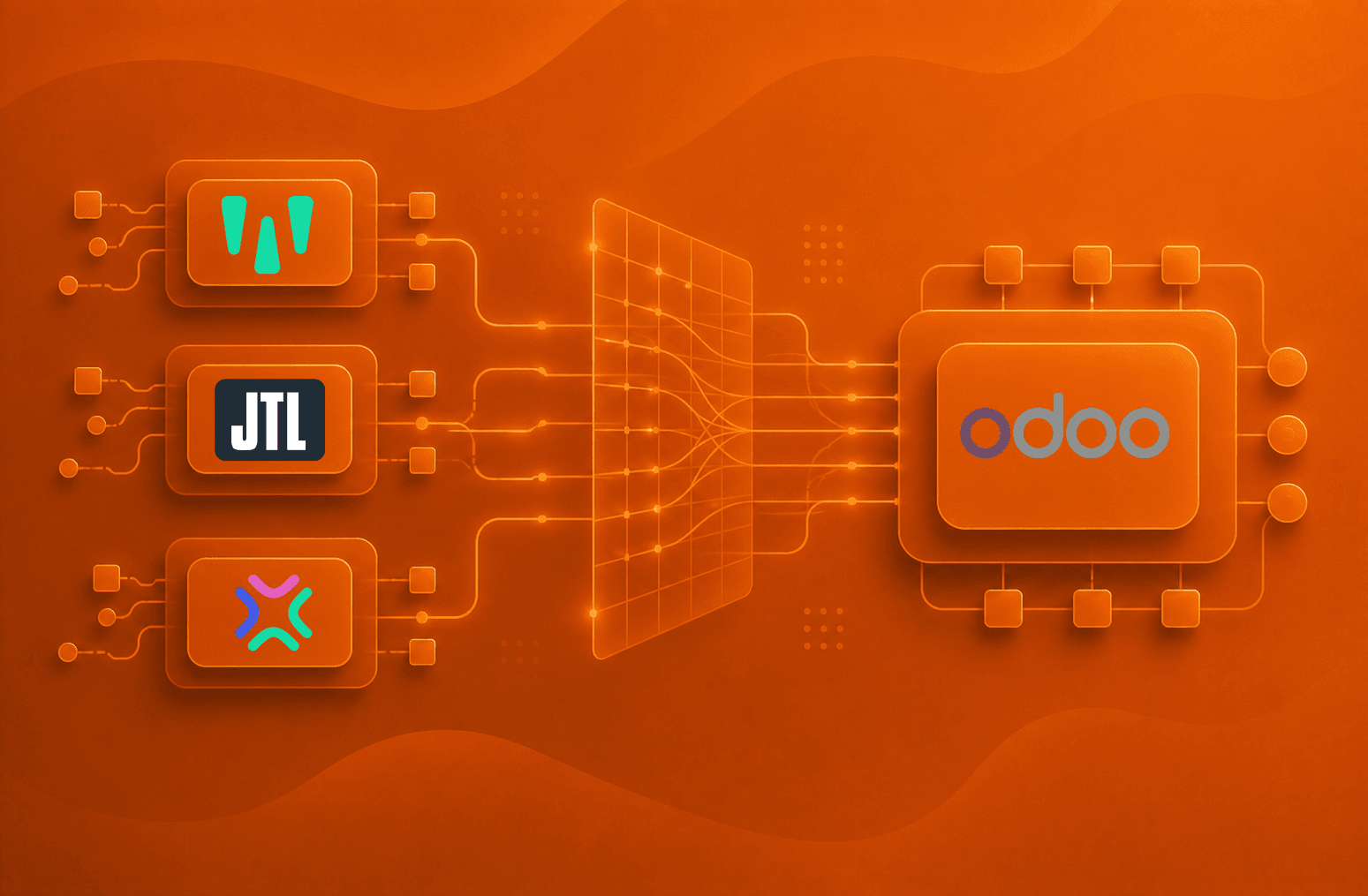
Switching ERP from weclapp, Xentral or JTL to Odoo: How companies migrate cleanly (process, risks and common mistakes)

ERP Implementation: 7 Risks That Make Projects Fail (and How to Spot Them Early)

Controlling ERP in E-Commerce: How to Scale Without Losing Financial Control

Customer Service ERP: How to Integrate Service, ERP and Logistics Properly

E-Commerce Accounting ERP: When 60,000 Monthly Bookings Break Your System

E-Commerce Logistics & ERP: Why Fulfillment Becomes Structural at Scale

E-Commerce Inventory Planning: Why It Breaks at €20M and How to Fix It
Made with🫀in Berlin © 2026 bobco GmbH
Made with🫀in Berlin © 2026 bobco GmbH
Made with🫀in Berlin © 2026 bobco GmbH