12 E-Commerce operators share how they scale operations. → Get the ERP Playbook.
What Is the Best ERP System? … and Why That’s the Wrong Question
What Is the Best ERP System? … and Why That’s the Wrong Question

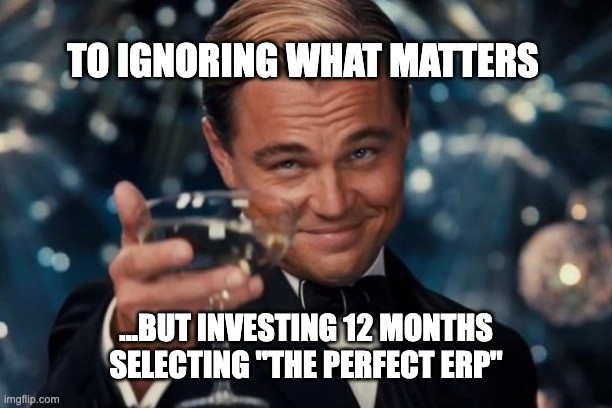
"Whats the best ERP system?", I don’t know how many times I’ve been asked this question.
And if there’s one thing I’ve learned over the past ten years, it’s this: ERP initiatives rarely fail because a company chooses the “wrong” ERP system.
They fail because organizations try to solve structural, organizational, and decision-making problems with software.
And yet, people love to spend months—often an entire year—discussing exactly this question. Working groups are formed. Business cases are calculated. Evaluation matrices grow more complex with every iteration.
Almost as if choosing the right tool could magically resolve every underlying issue. Choose once, and everything will finally be calm.
And yes, I get why this is so tempting. Because the question “What is the best ERP system?” feels safe. It promises control. It reduces a large, diffuse risk into what looks like an objective, rational decision.
If you’re reading this, you’re probably not just looking for “another tool.” This text is for you if at least one of the following sounds familiar:
Your company is growing—but your processes are becoming more fragile, not simpler.
You have many systems, but no single, reliable source of truth.
Your teams spend more time coordinating, double-checking, and correcting than creating value.
Inventory numbers don’t match. Forecasts are unreliable. Finance, operations, and sales look at different figures.
And at some point, this sentence inevitably appears:
“We need an ERP now.”
That’s not a wrong thought. But it’s often an incomplete one.
Why ERP Selection Creates So Much Fear—and Why That’s Misleading
For decision-makers, ERP carries serious weight.
ERP means:
significant investment
long-term commitment
little room for reversal
high visibility at C-level
A wrong decision isn’t just expensive—it can be career-defining.
Everyone in the room knows this.
And so, in practice, the same patterns repeat themselves:
Teams look for the safest option
They gravitate toward well-known brands
Or they follow the recommendation of the most influential voice—often someone with ERP experience from a completely different context
Not because this solution is objectively the best fit.
But because it feels like the least risky choice.
The problem is: This kind of safety is often an illusion.
Spoiler Alert: Most ERP Decisions Are Not Truly Analytical
A huge amount of energy is spent comparing systems.
Very little is spent questioning whether the organization is actually ready to make good use of an ERP.
In reality, we see the same things over and over again:
Evaluation matrices look clean, but decisions are driven by politics or fear
A system feels “right” because it’s familiar—not because it fits
The real bottlenecks remain untouched
And this is where the real risk begins.
"Whats the best ERP system?", I don’t know how many times I’ve been asked this question.
And if there’s one thing I’ve learned over the past ten years, it’s this: ERP initiatives rarely fail because a company chooses the “wrong” ERP system.
They fail because organizations try to solve structural, organizational, and decision-making problems with software.
And yet, people love to spend months—often an entire year—discussing exactly this question. Working groups are formed. Business cases are calculated. Evaluation matrices grow more complex with every iteration.
Almost as if choosing the right tool could magically resolve every underlying issue. Choose once, and everything will finally be calm.
And yes, I get why this is so tempting. Because the question “What is the best ERP system?” feels safe. It promises control. It reduces a large, diffuse risk into what looks like an objective, rational decision.
If you’re reading this, you’re probably not just looking for “another tool.” This text is for you if at least one of the following sounds familiar:
Your company is growing—but your processes are becoming more fragile, not simpler.
You have many systems, but no single, reliable source of truth.
Your teams spend more time coordinating, double-checking, and correcting than creating value.
Inventory numbers don’t match. Forecasts are unreliable. Finance, operations, and sales look at different figures.
And at some point, this sentence inevitably appears:
“We need an ERP now.”
That’s not a wrong thought. But it’s often an incomplete one.
Why ERP Selection Creates So Much Fear—and Why That’s Misleading
For decision-makers, ERP carries serious weight.
ERP means:
significant investment
long-term commitment
little room for reversal
high visibility at C-level
A wrong decision isn’t just expensive—it can be career-defining.
Everyone in the room knows this.
And so, in practice, the same patterns repeat themselves:
Teams look for the safest option
They gravitate toward well-known brands
Or they follow the recommendation of the most influential voice—often someone with ERP experience from a completely different context
Not because this solution is objectively the best fit.
But because it feels like the least risky choice.
The problem is: This kind of safety is often an illusion.
Spoiler Alert: Most ERP Decisions Are Not Truly Analytical
A huge amount of energy is spent comparing systems.
Very little is spent questioning whether the organization is actually ready to make good use of an ERP.
In reality, we see the same things over and over again:
Evaluation matrices look clean, but decisions are driven by politics or fear
A system feels “right” because it’s familiar—not because it fits
The real bottlenecks remain untouched
And this is where the real risk begins.
Hol dir das E-Commerce-ERP-Playbook
Hol dir das E-Commerce-ERP-Playbook
Ein strukturierter Leitfaden für die wichtigsten ERP-Entscheidung im wachsenden E-Commerce (+60 Seiten, 12 Expertinnen).
Ein strukturierter Leitfaden für die wichtigsten ERP-Entscheidung im wachsenden E-Commerce (+60 Seiten, 12 Expertinnen).
Mit Erfahrungen von Expert*innen, die täglich ERP, Ops & Zahlen verantworten.
Hol dir das E-Commerce-ERP-Playbook
Ein strukturierter Leitfaden für die wichtigsten ERP-Entscheidung im wachsenden E-Commerce (+60 Seiten, 12 Expertinnen).
Mit Erfahrungen von Expert*innen, die täglich ERP, Ops & Zahlen verantworten.
What Is the Real Goal of an ERP Implementation?
An ERP is not an IT project. And it’s not a goal in itself.
The real objective is this:
Your core business processes should become integrated, controllable, and reliable—across teams and departments.
In most growing companies, this includes:
Procurement & purchasing
Inventory, warehousing & fulfillment
Sales, CRM & quoting
Finance, accounting & controlling
Depending on the model: production, services, subscriptions, B2B-specific logic
When this works, something surprisingly unspectacular but crucial happens:
The organization becomes calmer. Less friction. Fewer exceptions. Fewer operational surprises.
More clarity. More reliability. Better decisions.
A Short Detour: What Is an ERP System, Really?
When companies want to increase productivity with software, they have two options:
Build their own solution
Buy an existing one
ERP clearly belongs to the second category—but with an important caveat.
An ERP is not a company in software form.
Even though standard structures are delivered (think of it like a Lego set), an ERP remains a generic system with a lot of potential—but no context.
The difference between:
“ERP implemented” and
“ERP delivers real, measurable value”
is almost always created by:
clear decisions
well-designed processes
strong implementation
change management & adoption
continuous improvement
In other words: ERP is far less about tools—and far more about organizational work, supported by systems.
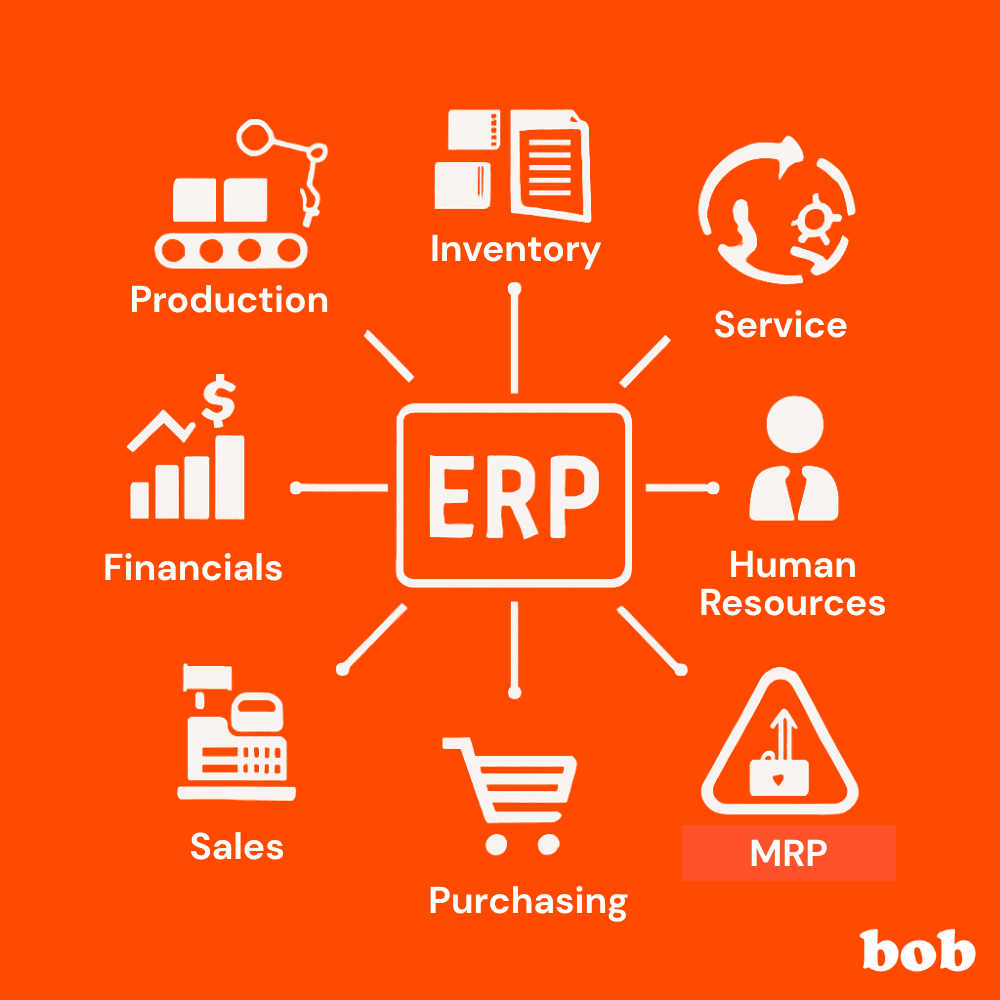
So the Real Question Isn’t: Which ERP?
It’s this:
Is our organization actually set up in a way that allows an ERP to create impact?
To answer that honestly, you need to look at three levels.
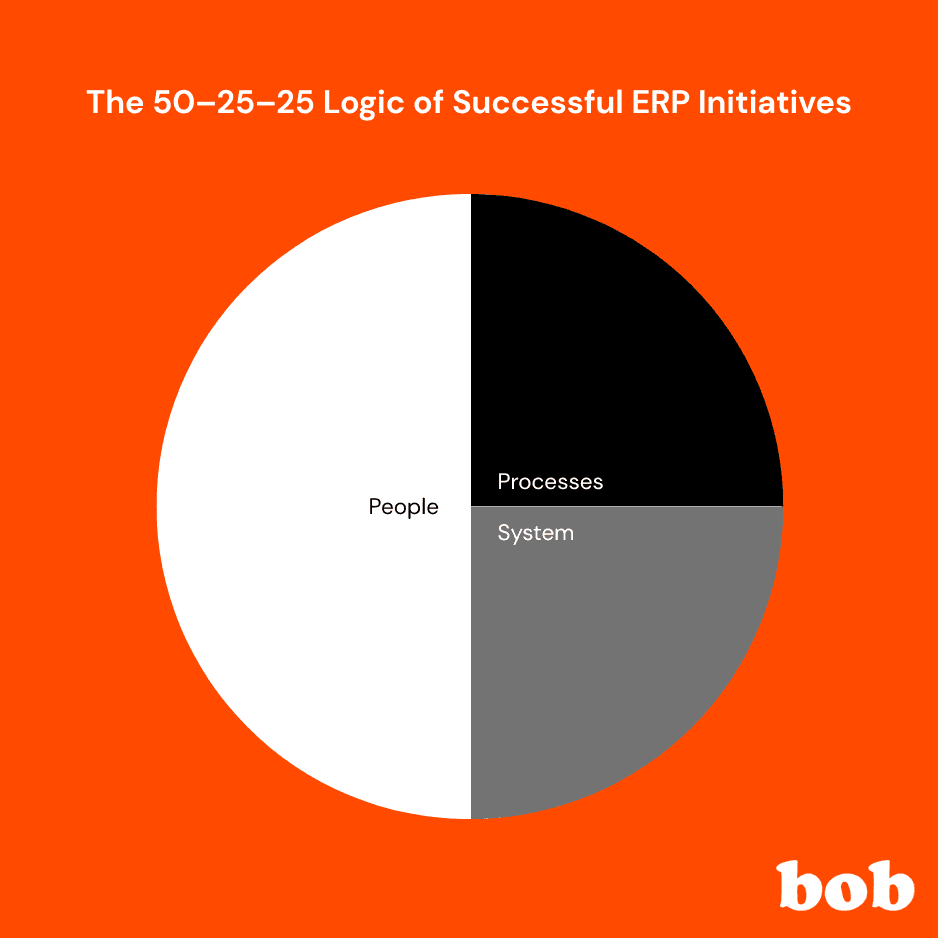
The 50–25–25 Logic of Successful ERP Initiatives
50% People
25% Processes
25% System
That’s exactly why so many projects fail despite choosing a “good” ERP.
1) Organization & Decision-Making Capability
Very concretely:
Who owns which processes?
Do real process owners exist—or only coordination rounds?
Are leaders empowered to make decisions without securing approval across three layers?
Or is responsibility outsourced to committees?
ERP forces decisions.
If no one makes them explicitly, the system will make them implicitly—and that always comes back to bite later.
2) Capabilities & Ownership
ERP is not an “IT will handle it” topic.
Key questions include:
Is tech/IT close to the actual business problems?
Do the people involved understand both process logic and system logic?
Do you want to build internal capability long-term—or consciously rely on a partner?
Many wrong decisions don’t happen during selection—but after go-live, when no one truly owns the system.
What Is the Real Goal of an ERP Implementation?
An ERP is not an IT project. And it’s not a goal in itself.
The real objective is this:
Your core business processes should become integrated, controllable, and reliable—across teams and departments.
In most growing companies, this includes:
Procurement & purchasing
Inventory, warehousing & fulfillment
Sales, CRM & quoting
Finance, accounting & controlling
Depending on the model: production, services, subscriptions, B2B-specific logic
When this works, something surprisingly unspectacular but crucial happens:
The organization becomes calmer. Less friction. Fewer exceptions. Fewer operational surprises.
More clarity. More reliability. Better decisions.
A Short Detour: What Is an ERP System, Really?
When companies want to increase productivity with software, they have two options:
Build their own solution
Buy an existing one
ERP clearly belongs to the second category—but with an important caveat.
An ERP is not a company in software form.
Even though standard structures are delivered (think of it like a Lego set), an ERP remains a generic system with a lot of potential—but no context.
The difference between:
“ERP implemented” and
“ERP delivers real, measurable value”
is almost always created by:
clear decisions
well-designed processes
strong implementation
change management & adoption
continuous improvement
In other words: ERP is far less about tools—and far more about organizational work, supported by systems.
So the Real Question Isn’t: Which ERP?
It’s this:
Is our organization actually set up in a way that allows an ERP to create impact?
To answer that honestly, you need to look at three levels.
The 50–25–25 Logic of Successful ERP Initiatives
50% People
25% Processes
25% System
That’s exactly why so many projects fail despite choosing a “good” ERP.
1) Organization & Decision-Making Capability
Very concretely:
Who owns which processes?
Do real process owners exist—or only coordination rounds?
Are leaders empowered to make decisions without securing approval across three layers?
Or is responsibility outsourced to committees?
ERP forces decisions.
If no one makes them explicitly, the system will make them implicitly—and that always comes back to bite later.
2) Capabilities & Ownership
ERP is not an “IT will handle it” topic.
Key questions include:
Is tech/IT close to the actual business problems?
Do the people involved understand both process logic and system logic?
Do you want to build internal capability long-term—or consciously rely on a partner?
Many wrong decisions don’t happen during selection—but after go-live, when no one truly owns the system.
Hol dir das E-Commerce-ERP-Playbook
Ein strukturierter Leitfaden für die wichtigsten ERP-Entscheidung im wachsenden E-Commerce (+60 Seiten, 12 Expertinnen).
Mit Erfahrungen von Expert*innen, die täglich ERP, Ops & Zahlen verantworten.
3) Processes & Reality
Before an ERP improves anything, it does one thing extremely well:
It exposes everything that is unclear, inconsistent, or historically grown.
That’s why these questions matter:
What is standard—and what is an exception?
Where do manual corrections happen today?
Which special cases are truly necessary?
Which KPIs do you actually want to manage reliably in the future?
ERP amplifies what already exists.
The good and the bad.
“First Check If You’re Ready”—But How?
This is exactly where we start at bob. Not with tool pitches. Not with rushed decisions.
But with a structured discovery or pre-project phase, where we clarify together:
Where are you really standing? (People, Process, Tech)
What are the true bottlenecks—not just symptoms?
What needs to be decided or cleaned up before an ERP makes sense?
What should come first—and what should consciously come later?
The result is a solid, defensible decision base. Sometimes that means: start the ERP. Sometimes it means: do your homework first. And sometimes it means: don’t invest yet—and save a lot of money.
Why We Get This
Many of our clients are caught between two risks:
Not investing—and being operationally constrained
Investing incorrectly—and locking themselves in long-term
Both are dangerous. That’s why it’s not about being bold or cautious. It’s about making informed, structured decisions. And that’s exactly what we help with.
Conclusion
If you’re currently searching for “the best ERP system”, ask yourself this first:
Have we created the conditions that allow an ERP to actually work for us?
If yes—great. Then the system question is worth asking.
If not—that’s exactly where real consulting begins.
3) Processes & Reality
Before an ERP improves anything, it does one thing extremely well:
It exposes everything that is unclear, inconsistent, or historically grown.
That’s why these questions matter:
What is standard—and what is an exception?
Where do manual corrections happen today?
Which special cases are truly necessary?
Which KPIs do you actually want to manage reliably in the future?
ERP amplifies what already exists.
The good and the bad.
“First Check If You’re Ready”—But How?
This is exactly where we start at bob. Not with tool pitches. Not with rushed decisions.
But with a structured discovery or pre-project phase, where we clarify together:
Where are you really standing? (People, Process, Tech)
What are the true bottlenecks—not just symptoms?
What needs to be decided or cleaned up before an ERP makes sense?
What should come first—and what should consciously come later?
The result is a solid, defensible decision base. Sometimes that means: start the ERP. Sometimes it means: do your homework first. And sometimes it means: don’t invest yet—and save a lot of money.
Why We Get This
Many of our clients are caught between two risks:
Not investing—and being operationally constrained
Investing incorrectly—and locking themselves in long-term
Both are dangerous. That’s why it’s not about being bold or cautious. It’s about making informed, structured decisions. And that’s exactly what we help with.
Conclusion
If you’re currently searching for “the best ERP system”, ask yourself this first:
Have we created the conditions that allow an ERP to actually work for us?
If yes—great. Then the system question is worth asking.
If not—that’s exactly where real consulting begins.
More articles

How to Start an ERP Project Successfully: 9 Decisions That Need to Be Made Before Implementation
Switching ERP from weclapp, Xentral or JTL to Odoo: How companies migrate cleanly (process, risks and common mistakes)

ERP Implementation: 7 Risks That Make Projects Fail (and How to Spot Them Early)

Best-of-Breed vs. Best-of-Suite in Mid-Market: HubSpot vs. Odoo in a Reality Check

Controlling ERP in E-Commerce: How to Scale Without Losing Financial Control

Customer Service ERP: How to Integrate Service, ERP and Logistics Properly

E-Commerce Accounting ERP: When 60,000 Monthly Bookings Break Your System

E-Commerce Logistics & ERP: Why Fulfillment Becomes Structural at Scale

Made with🫀in Berlin © 2026 bobco GmbH
Made with🫀in Berlin © 2026 bobco GmbH
Made with🫀in Berlin © 2026 bobco GmbH